
I had a student at MOP ask me something equivalent to “how should I study while at MOP?”1 For those of you that don’t know, MOP is the three-week summer camp for the USA’s team to the IMO.
At first I was going to just link my FAQ. But then I thought about it a bit more, and I was surprised to find that my answer was not the same as the general how-to-study FAQ. The additional condition “while at MOP” was enough to cause me to stay up that night writing an entirely different answer. That answer is this blog post.
MOP is short
There’s a misconception2 that MOP students are going to improve a ton by locking themselves in their room and working intensely for the whole camp, and come away suddenly much stronger.
There’s a reason this can’t possibly work: MOP is only 3 weeks long. You cannot just put a sudden spike in intensity for that short of a period of time and expect to suddenly go up several levels. If you tried to do math for 17 hours a day over three weeks, you’d still be spending fewer hours than if you just did 1 hour of math a day over the year. The numbers are just not there.
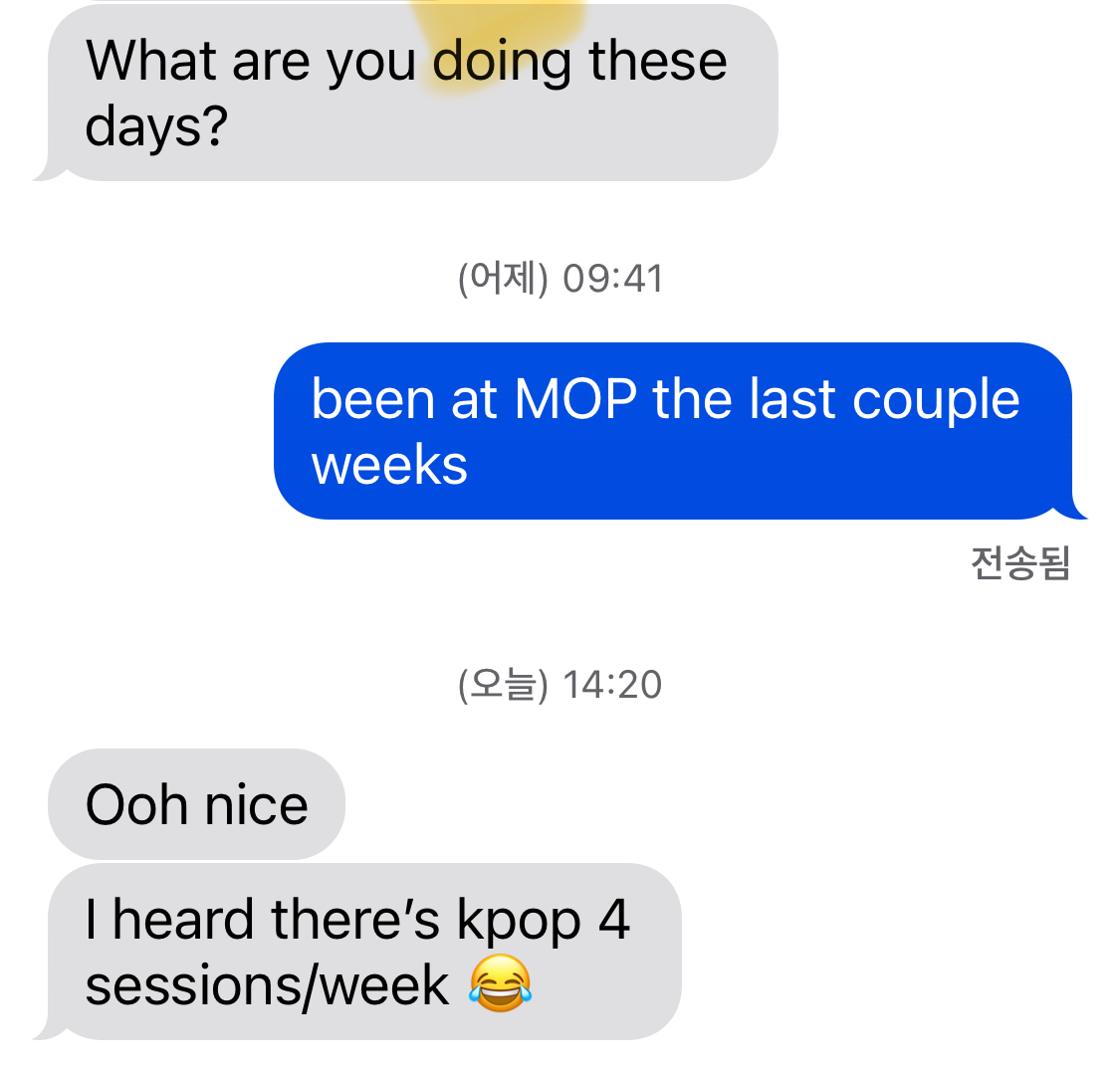
Indeed, one of the most common things I hear from first-time MOPpers is surprise that there is less scheduled math than expected: there’s “only” one full-length (4.5 hour) exam every two days, not daily.3 We actually had more K-pop rehearsals scheduled this year than tests (11 vs 8).
But there is something at MOP not normally available: living on campus with students and instructors. And there’s something really valuable there.
Unfortunately, “learning from others” is a cliché. So to make this post actually useful, I want to distill this into two specific ideas:
- Seek out moments where teachers or classmates do things you didn’t expect.
- Use this to inform yourself later on in the year rather than trying to master everything right away.
Overall my thesis is going to be that watching experts should carry much more information than just “wow, this person is really orz”. In chess, telling you that “it’s possible to have a FIDE rating of 2800” might be inspirational but is otherwise useless for actually improving. But actually watching a grandmaster game — down to the individual moves — and seeing a piece moved that you totally didn’t expect should give you a lot to think about.
Now let me drill down with some specific mathematical examples.
Moments of surprise
Taiwan 2000/4
One thing a lot of people will do at MOP is to work in-person with peers (I believe this generation uses the term “group-solving”). This is a good time to learn from your peers.
A specific example I remember when I was growing up was when I was working on Taiwan 2000/4 with a classmate way back in 2011, We got to the equation 


Growing up I would absolutely never have thought quadratic reciprocity could be used in this way. I still remember that problem almost 15 years later.
TSTST 2016/4
Here’s another story: while working on TSTST 2016/4, a lot of students (in the real exam) tried to prove the optimistic claim that 


So this is something I’d do differently if I was teaching a class: I would actually interrupt the student and tell them they’re making a mistake. In this case, I am not just telling the student that the claim is wrong. I want to signal that you also could know right away from experience that the claim is false (and why).
There’s a school of thought that maybe you should let the students make their own mistakes, and realize for themselves in an hour or two that the claim is false. I have mixed feelings about this. But during MOP, I’m definitely okay with breaking that guideline and being a lot more heavy-handed, exactly to make a point.
Seeing the vision
Zooming out a bit more, learning perspectives is generally powerful.4 I think this is often what instructors are trying to do when they structure their classes — these days, MOP classes are often no longer about providing a list of important theorems, but instead about trying to showcase some particular idea or perspective.
I’d say then the goal of each class is not to master the theme, because that’s impossible: wisdom is not acquired in 90-minute sessions. Instead, the goal for the student is see that a certain style or philosophy exists at all, complete with enough examples for concreteness. This sort of gives you a mental map that you can use to guide yourself later on during the school year.
You could try to ask for wisdom directly. For example, this year I had a student ask me how I thought about complex numbers. I said a few bits of general wisdom like
- how you want to eventually be able to judge the execution time of a setup just by looking at it;
- how small changes in the setup can affect the time a lot;
- how I think the best geometers think about making progress about the problem using all methods simultaneously rather than committing to one.
And then I gave a specific example problem5 to showcase this because this kind of advice is worthless without examples.
But my point is that, even with a fully worked example for illustration, none of this advice will change anyone overnight. However, over the next 3 or 6 or 12 months it could tell you where you’re trying to go. My hope is for a moment or two later down the line where you say to yourself, “oh, that’s what Evan was talking about when he said so-and-so”.
“Knowledge,” said the Alchemist, “is harder to transmit than anyone appreciates. One can write down the structure of a certain arch, or the tactical considerations behind a certain strategy. But above those are higher skills, skills we cannot name or appreciate. Caesar could glance at a battlefield and know precisely which lines were reliable and which were about to break. Vitruvius could see a great basilica in his mind’s eye, every wall and column snapping into place. We call this wisdom. It is not unteachable, but neither can it be taught. Do you understand?”
- There is also a question about whether you should be studying much at MOP at all — you could also spend a lot of time making new friends, for example. That’s a value judgment that I think is better left to individuals and I won’t comment on it further in this post. ↩
- Often from the parents, actually. ↩
- To be fair, I’m not sure we could have more exams even if we wanted to. The practice exams get graded on turnarounds of about 30 hours. So we can have exams every 48 hours, but not every 24. ↩
- This is particularly true in Euclidean geometry. Even now it’s still surprising to me how differently people see geometry problems and how stylistic their solutions are. ↩
- Shortlist 2011 G7, if you’re curious, the same one I used at MOP way back in 2017, ↩

 Power Overwhelming