There are a lot of different kinds of math enrichment activities now,
ranging from olympiads to math circles to tons of summer programs and so on.
I work in the competition sphere, and I used to spend a lot of time worrying
about whether I took the right side.
Now that I’m a bit older, I came to the realization that maybe I don’t
need to be so intent on comparing my work to others
(even though I realize comparing yourself to others is human nature, haha).
I eventually told myself: there are lots of people who don’t like olympiad exams;
there are also lots of people who do, and it’s just okay for them to co-exist.
We don’t need to decide which of the N systems is the best and kill the other
N-1, because “best” is so different from person to person anyway …
Two pieces of news for high school math contest enthusiasts:
OTIS Mock AIME 2025
We’re running the OTIS Mock AIME again this year! It’ll go from December 19, 2024 to January 20, 2025.
New this year is that we’re offering two tests, I and II, and you can try either or both.
However, unlike the real AIME, the two versions are intentionally different:
The OTIS Mock AIME I is going to be tough.
It will definitely be harder than the actual AIME, by perhaps 2 to 4 problems.
But more tangibly, it will also have significant artistic license.
Problems will freely assume IMO-style background throughout the test,
and intentionally stretch the boundary of what constitutes an “AIME problem”.
The OTIS Mock AIME II is meant to be more practically useful.
It will adhere more closely to the difficulty and style of the real AIME.
There will inevitably …
This is a short blog post on the FrontierMath benchmark,
a set of lots of difficult math problems with easily verifiable answers.
Just to be clear, everything written here is my own thoughts
and doesn’t necessarily reflect the intention of any collaborators.
When you’re setting a problem for a competition like the IMO or Putnam,
three properties that are often considered desirable are:
It should require creative insight.
Competitions avoid problems that are too similar to existing ones
or too easily solved by simply applying standard textbook techniques.
You want the problems to really feel different
and force the solver to feel like they came up with a new idea to solve it.
This is sort of what the spirit of math olympiads is about.
It should not take a lot of implementation,
i.e. once a set of key ideas has been identified,
actually carrying out the …
There’s got to be a better way to do this. Someone please enlighten me.
Modern Korean is written in 한글 (Hangul), which uses a syllabic alphabet. It
includes spaces between words, unlike Chinese or Japanese, which means that it’s
possible to have meaningful spellchecking.
So of course one day I decided I wanted to configure Vim to support
spellchecking Hangul. Unfortunately, there’s no file ko.utf-8.spl at
ftp.vim.org, and in a cursory search I
couldn’t find an.
Twitch Solves ISL will resume on September 13, 2024 and September 20,
2024 at the usual time. Then a two-week break (because I’m traveling on both September 27 and October 4),
and then continuing on Fridays for some to-be-determined number of weeks. Check the calendar.
In addition, this Sunday (September 8) at 7PM EDT [EDIT: meant Sunday!
agh], by popular request from the otters,
I’ll be streaming a session where I work on part of the calculation that I need for my PhD thesis.
It’s not going to make any sense so I dunno why people want to see it, but give the kiddos what they want.
If it goes well I might run more of them.
USEMO dates
USEMO 2024 will take place 26 October 2024 - 27 October 2024 and is open to US students,
see the …
There’s this pet peeve I have where people sometimes ask things like what kind
of strategies they should use for, say, collinearity problems in geometry.
Like, I know there are valid answers like Menelaus or something.
But the reason it bugs me is because “the problem says to prove collinearity”
is about as superficial as it gets.
It would be like asking for advice for problems that have “ABC” in them.
To drive my point, consider the following setup:
Let ABC be a triangle with circumcircle Γ
and incenter I and let M be the midpoint of BC.
Denote by D the foot of the perpendicular from I to BC.
The line through I perpendicular to A …
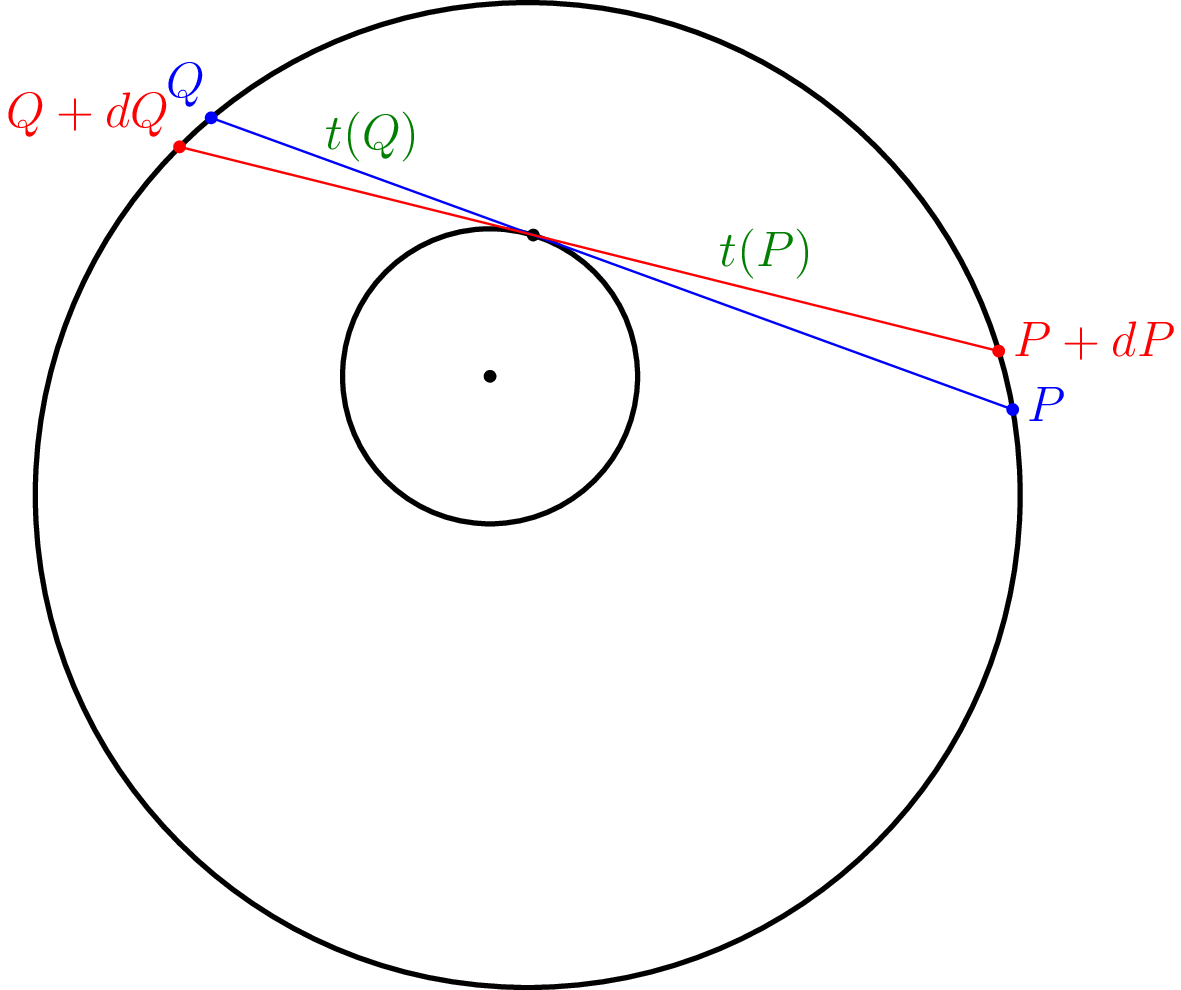
Brian Lawrence showed me the following conceptual proof of Poncelet porism in the case of two circles,
which I thought was neat and wanted to sketch here.
(This is only a sketch, since I’m not really defining the integration.)
Let P be a point on the outer circle,
and let Q be the point you get when you take the counterclockwise tangent from P to the inner circle.
Consider what happens if we nudge the point P by a small increment dP.
Figure for Poncelet porism proof.
The similar triangles in power of a point then give us the approximation
Okay. Imagine you’re, like, trying to make glazed carrots or something.
Maybe a really simplified recipe looks something like:
Cut your carrots into suitably sized pieces with a knife.
Use a measuring spoon to get the right amount of oil, sugar, salt, etc.
Throw the carrots and other ingredients into a frying pan.
Serve the carrots on a plate.
You’ll notice that there were a bunch of different tools you used.
The knife was used to cut the carrots into pieces.
The measuring spoon was used to get the right amounts of other ingredients.
And the plates are just there for the presentation of your dish.
All these tools are things you see in any kitchen,
but they do a single, completely unrelated thing.
Now imagine someone asks you:
I’m confused, why do people use a measuring spoon for cooking?
Why not just use …
The application and syllabus are pretty much going to be the same as in previous years;
here are some of the (mostly small) changes:
I deleted the question that used to ask about past contest results because I
never read the answers to it anyway.
The application problem set is one geometry problem shorter.
Problem C.1 had its description change from “Learn to code” to “Learn to code, please,
I implore you” to encourage more people to not skip the problem.
Reading Comprehension answers are now all nonnegative integers who sum is six
times a prime to make it harder for people to get the answers wrong when they submit a late application.
(For on-time application, the Google Form …
Where do all the smart, curious, earnest kids go these days?
One of my friends asked me this recently, and I wasn’t sure what to say.
In the last ten years, something has changed.
If I had to summarize my concerns in one sentence, I would say this:
kids these days no longer feel they’re allowed to work on what they’re
interested in or excited about.
Instead, they feel obligated to work on whatever happens to be considered
the most “important” (or “prestigious”) thing possible.It’s for this reason I consider ambition as a double-edged sword.
When ambition isn’t accompanied by excitement, earnestness, curiosity,
or interest, it doesn’t usually end well.
But let me do a bit of story-telling.
Hobbies
When I was kid, math contests were seen as a hobby, or sport, or game.
Those were the good old days.

 A poset of math programs