By popular request, Twitch Solves ISL is renewed for a second season which will begin on Friday,
18 November 2022.
As in the past, streams will start at 8:00pm Eastern time on Friday nights,
and last 1-4 hours depending on how much coffee I drank that morning.
I’ve scheduled 26 episodes for the second season to follow anime standards;
this will last up through the spring semester of MIT, around May 2023.
That said, my holiday plans are to-be-determined so things are likely to change
around a bit around the end of December or early January.
The stream scheduled for 13 January 2023 is also likely to be modified due to
the 2023 Mystery Hunt,
which I’m nominally on the organizing team for (though I’m only helping a little bit this year).
After two years, 480 hours, and 102 episodes of Twitch Solves ISL,
I’ve finally decided that it’s time for me to take a hiatus from my weekly Friday night streams.
So, episode 102 will be the end of Season 1.
To answer the obvious question: I’m definitely open to having a Season 2,
although it will probably have to wait until after the summer (as I will be away from my stream setup then),
and it probably won’t last 100 episodes.
Between now and then, I might also sporadically stream video game sessions if I’m in the mood for it,
so if you come by Friday night, you might get to watch me play through something from my Steam library.
I’d like to thank all my viewers and 1800 followers on Twitch, for being such a great audience all …
I get a lot of questions that are so general
that there is no useful answer I can give, e.g.,
“how do I get better at geometry?”.
What do you want from me? Go do more problems, sheesh.
These days, in my instructions for contacting me,
I tell people to be as specific as possible
e.g. including specific problems they recently tried and couldn’t solve.
Unsurpisingly the same kind of people who ask me a question like that
are also not the kind of people who read instructions,
so it hasn’t helped much. 😛
But it’s occurred to me it’s possible to take this too far.
Or maybe more accurately, it’s always better to ask a specific question,
but sometimes the best answer will still be “go do more problems, sheesh”.
Makes it feel a bit more rewarding to complete problem sets, I think.
Also gives me the chance to plant Easter eggs everywhere,
which is always a lot of fun ;)
This is a pitch for a new text that I’m thinking of writing.
I want to post it here to solicit opinions from the general community before
investing a lot of time into the actual writing.
Summary
There are a lot of students who ask me a question isomorphic to:
How do I learn to write proofs?
I’ve got this on my Q&A. For the contest kiddos out there,
it basically amounts to saying “read the official solutions to any competition”.
But I think I can do better.
Requirements
Calling into question the obvious, by insisting that it be “rigorously proved”, is to say to a student,
“Your feelings and ideas are suspect. You need to think and speak our way.”
Now there is a place for formal proof in mathematics, no question.
But that place is not a student’s first introduction to mathematical argument.
At …
I might be going too far with this Arch Linux brand loyalty, but I am so psyched I don’t care.
💸
There’s three pieces of hardware that I’ve always kind of wanted but never been
willing to spend money on in isolation:
A handheld gaming console
A laptop with a touch screen
A laptop with enough power to play games on a Steam library (my laptop is a bit too old for this)
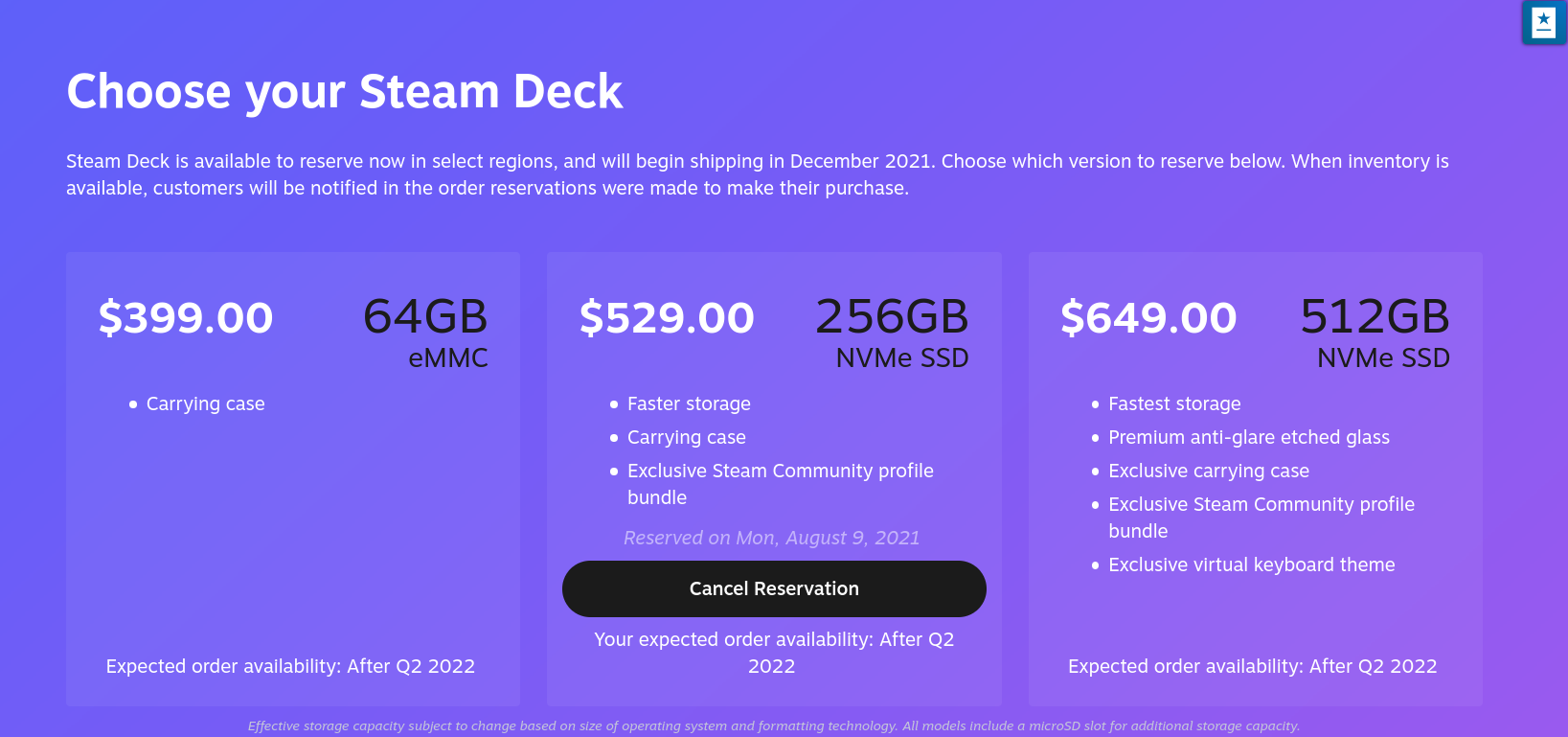
So when I heard the Steam Deck existed and it would be running an Arch Linux system beneath it,
I totally caved.
I’m just sad I didn’t hear about in time to be early enough in the queue to get it by Christmas. Ah well.
In unrelated news, careful readers might notice that the blog has been moved to blog.evanchen.cc.
I think the old URL usamo.wordpress.com will continue to …
Sometime this week the American Math Competitions released the following new policy:
For the IMO, EGMO, RMM, TSTSTs, and TSTs, and MOP, students must be US citizens or US permanent residents.
Visas are not a valid substitute.
(AMC Policies)
I want to make a rather brief statement on why I was opposed to this change.
To do this I want to draw an analogy.
In the American Math Competitions, students are asked what gender they identify with,
which is used to determine whether they are eligible for the
European Girl’s Math Olympiad and also for invitations to MOP.
This means that in theory, you could try to abuse the system by
deliberately misrepresenting your self-identified gender.
But in practice, nobody has attempted this.
So, we continue to allow students to self-identify their gender,
in order to make sure to be inclusive to students with gender dysphoria,
and trusting our …
I worked with a few friends on writing a mini one-round puzzle hunt for this year’s MOP students.
If you want to play, you can do so now at the following URL:
I’m not sure whether or not this is going to become a recurring tradition.
On the one hand, it was loads of fun to make
(including figuring out how to draw art on my iPad);
on the other hand, I definitely didn’t blow a couple hundred hours
of my life putting this together. ;)
Unrelated advertisement: the Carina Initiatives
is currently looking to hire a junior data scientist.
They’re a young philanthropic fund that’s interested in supporting initiatives
that build actual math problem solving (like, the problem-solving you’d see on this blog,
not the mainstream buzzword stuff).
I’ve had a lot of fun talking with them over the …
As a follow-up to the previous post,
I am recording here some details about the (numerous, varied, and deep)
revisions that a bunch of my puzzles went through during the production process.
These puzzles are in chronological order of when I wrote the puzzle.
Spoiler warning:
Unlike the last post, these will completely spoil all of the puzzles below.
Surprisingly, the gist of the puzzle mostly survived revisions:
the idea of an encoding-based puzzle with the
key step to look at seven-segment displays between the Braille and resistor color encoding.
One issue I ran into while constructing was that
ABCDEF6 is actually too big in base 16 to store in an eight-bit number,
which is part of why I ended up 1337-ing the seven-segment display bits.
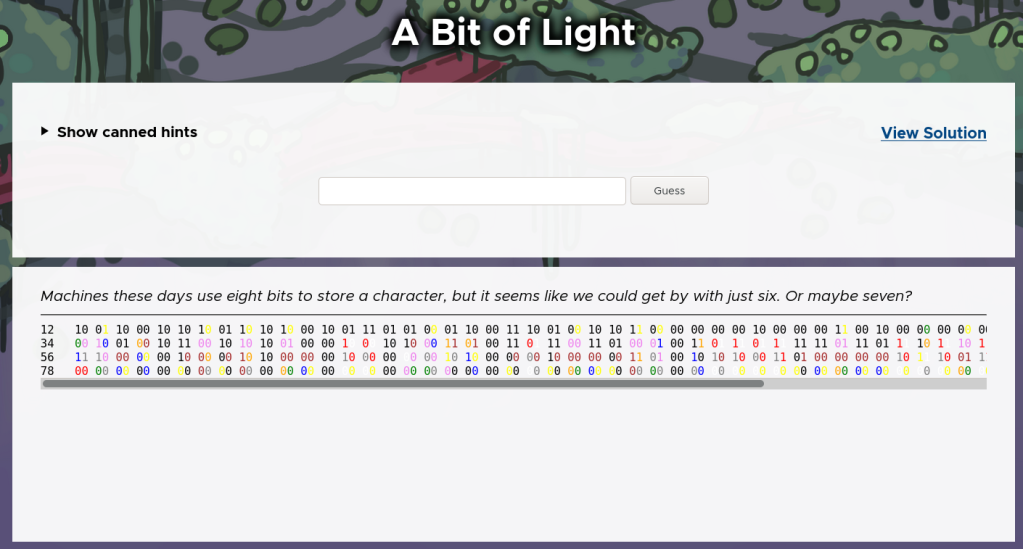
The final presentation of the “A Bit of Light” puzzle;
it looked pretty much like this at the start …
The 2021 Mystery Hunt
concluded a while ago, and wow, what an experience.
I was lucky enough to be on the organizing team,
and I am so proud right now to be able to say I am a ✈️✈️✈️ Galactic Trensdetter ✈️✈️✈️.
(If you don’t know what a puzzle hunt is,
betaveros has a great introduction.)
I came in to the MIT Mystery Hunt with no writing experience at all,
and ended up being listed as the author of a few.
It was a trial by fire, to say the least.
In this post I want to say a bit about the parts
of the puzzle-writing process that surprised me the most,
in the hopes that maybe it would be helpful to future authors.
A nice introduction is given by e.g.
David Wilson,
which I read many times before I actually attempted to write my first puzzle.
Most of what …

 Twitch Solves ISL, Season 2