For me the biggest difference between undergraduate math and PhD life
has been something I’ve never seen anyone else talk about:
it’s the feeling like I could no longer see the ground.
To explain what this means, imagine that mathematics is this wide tower,
where you start with certain axioms as a foundation,
and then you build upwards on it.
At first learning math felt like slowly climbing up this tower.
When I reached a landmark, it felt like I was on the balcony
of the 30th or 50th or 100th floor, enjoying the view,
with an appreciation of the floors I had ascended to get here.
In theory, proofs in math can be formalized as a
long sequence of logical steps from the axioms that could be
computer-verified.
This turns out to way too cumbersome to actually do in practice given
the current state of technology (though …
The Carina Initiatives (https://carina.fund) is a friend of the math education
community which has supported organizations like Art of Problem Solving, BEAM, Athemath,
and others.
They’re starting a math talent search organization in the United States and are
looking to hire a full-time leader (salary $200K-$250K).
Passing this along in case anyone in this space might be interested in applying
or knows someone who might be. The link to apply is:
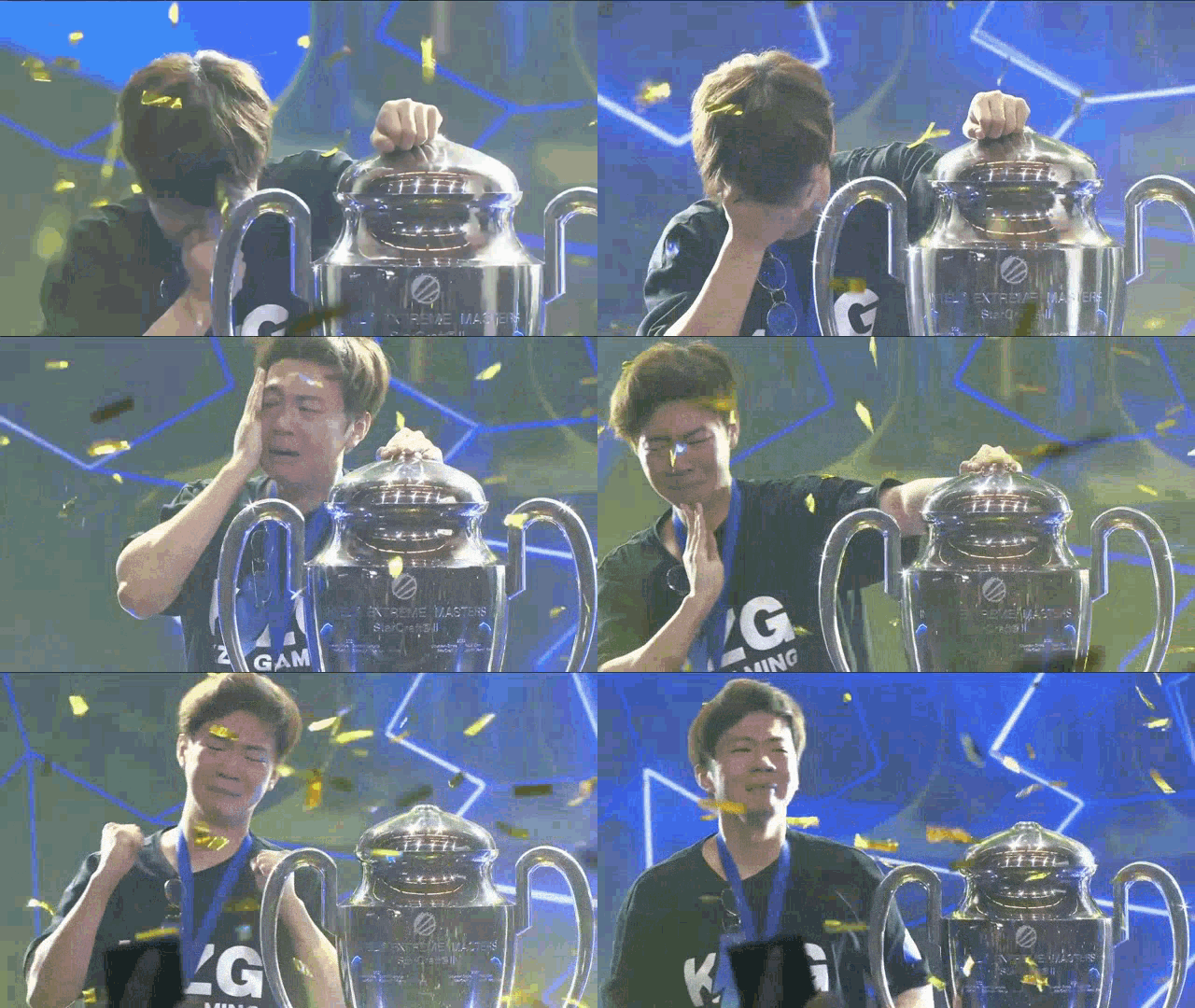
Last weekend in StarCraft, the world championship at IEM Katowice 2023
saw a so-good-it-must-be-scripted Cinderella story,
where Oliveira won the world championship in a totally unexpected way.
It was a whole roller-coaster of upset after upset from Oliveira,
and up until the grand finals we were all still asking,
“this can’t be, is this really happening?”.
Some context: StarCraft has one of the lowest upset rates
of any competitive game out there, and Oliveira (formerly known as TIME)
was ranked something like #21 coming in.
Last November at DreamHack Atlanta (which I was at!),
he didn’t win a single map. And just a month before IEM 2023,
Blizzard had shut down its Chinese servers.
But he’d been practicing 12 to 15 hours a day lately, and it showed.
The final winner interview
was so emotional not only did Oliveira start crying,
the host also started crying …
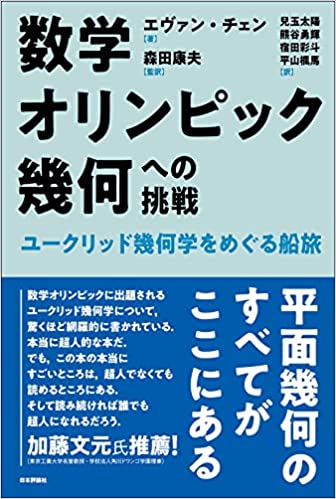
I’m happy to thank 日本評論社 and their team (Fuma Hirayama, Yuki Kumagae, Taiyo Kodama, Ayato Shukuta,
among others) for making the Japanese translation a reality.
As well as tripling the length of the errata PDF :)
This marks the second translation of the EGMO textbook (a Chinese translation
was published a while ago as well by Harbin Institute of Technology). Both linked below:
Japanese translation at nippyo.co.jp and amazon.co.jp.
ISBN-10: 4535789789 / ISBN-13: 978-4535789784.
Chinese translation at abebooks
and amazon.
ISBN-10: 7560395880 / ISBN-13: 978-7560395883.
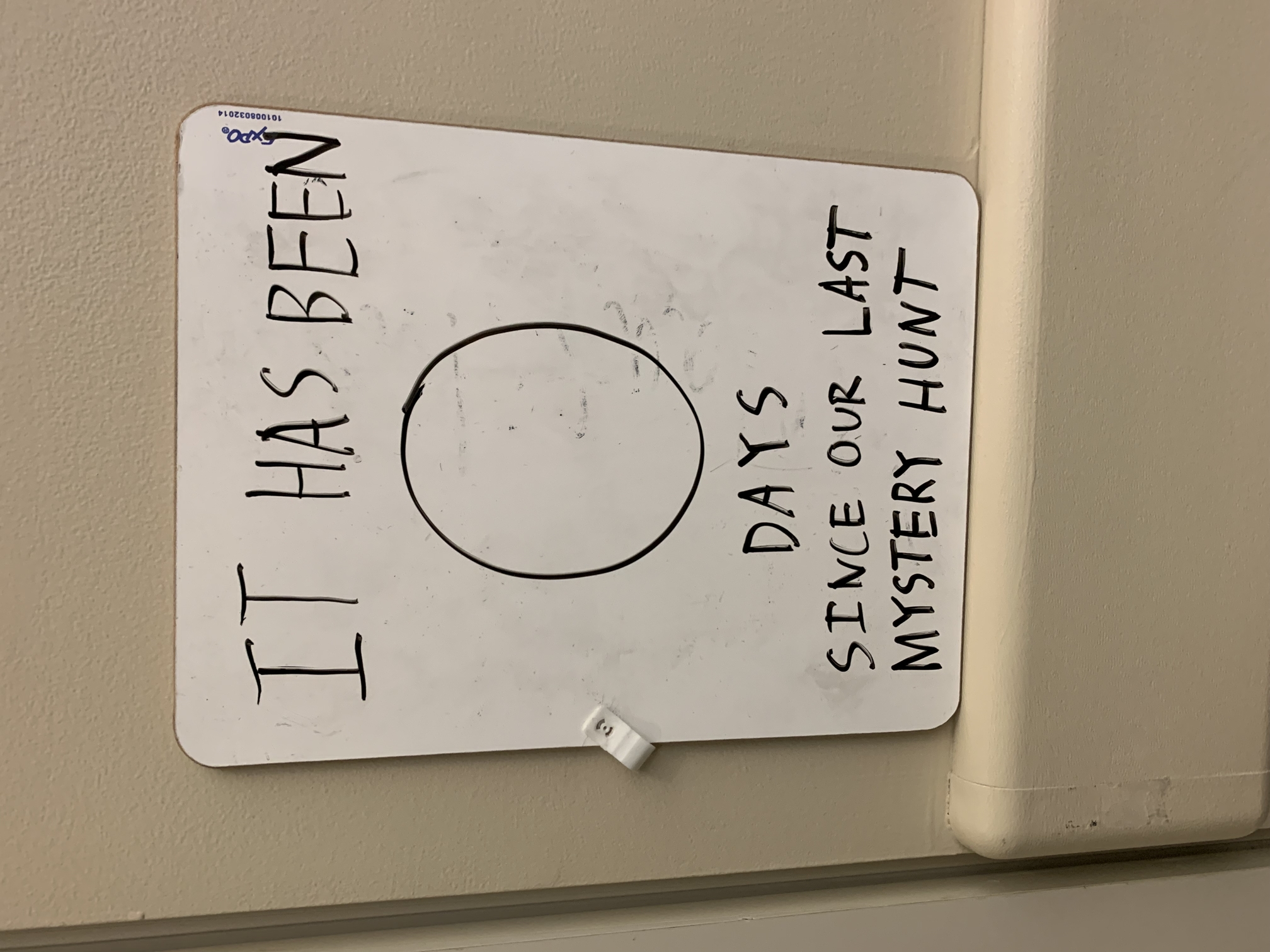
This is a retro-post for the Mystery Hunt 2023,
for which I played a somewhat minor role on the organizing team (teammate).
You can play at interestingthings.museum.
Office décor.
There is an ongoing list of write-ups about the hunt being kept at
puzzles.wiki,
and you may also be interested in the
reddit AMA from teammate.
There’s a common error I keep seeing on OTIS applications, so I’m going to
document the error here in the hopes that I can preemptively dispel it.
To illustrate it more clearly, here is a problem I made up for which the bogus
solution also gets the wrong numerical answer:
Problem: Suppose a2+b2+c2=1 for positive real numbers a, b, c.
Find the minimum possible value of S=a2b+b2c+c2a.
The wrong solution I keep seeing goes like so:
Nonsense solution: By AM-GM, the minimum value of S is
A while ago someone asked me how COVID had affected the students I worked with.
I replied that, on average, the pandemic had tripled my students’ productivity.
And I’m gonna brag about it like the proud teacher I am.
The list of errata is now version controlled on GitHub:
vEnhance/egmo-book-errata.
So now you can actually see a changelog of the ocean of typos as they come in.
Shout-out to the crew working on the Japanese translation of the book for
finding way more errors than I will ever care to admit (I didn’t count,
but it’s probably in the 200-300 ballpark).
I took a snapshot my database entries for sourced problems in EGMO.
It turns out that I have many written up already,
so we now have something of a solutions manual for about half the problems or so.
Since I like idiotic names, I dubbed it the Automatically Generated EGMO Solutions Treasury.
Some people have asked me why I anti-recommend JavaScript for beginners
on my website FAQ.
This post will try to give a few reasons why.
Some notes:
I’m referring to base JS. I like TypeScript a lot for example (it’s high on
my tier list of programming languages for beginners).
And I know about eslint, but you asked me about recommendations for
beginners, and I think beginners shouldn’t have to worry about setting up an
IDE with strict linting until after they can write a for loop by
themselves without screwing up.
I have multi-file projects in mind. I don’t have a problem with using inline
JavaScript for tiny 20-line snippets of code embedded in a webpage.
I’m an amateur programmer. Professional programming is a different ball game.
Weak typing
I’m clumsy. I make many more mistakes than the average programmer.
The other day …
So you have a fair coin that you found on the ground,
or at least that’s what everyone says.
But on each of N times that you’ve tossed it around,
you see every flip has been heads.
For which value of N should you start to suspect
that the coin isn’t actually fair?
For which values of N can you firmly declare
that the tails side is not even there?

 Everything I need is on the ground