Careful readers of my blog might have heard about plans to
have a second edition of Napkin out by the end of February.
As it turns out I was overly ambitious, and
(seeing that I am spending the next week in
Romania)
I am not going to make my self-imposed goal.
Nonetheless, since I did finish a decent chunk of what I hoped to do,
I decided the perfect is the enemy of the good and that I should at least put up what I have so far.
So since this is someplace between version 1 and the (hopefully eventually) version 2,
it seems appropriate to call it version 1.5.
The biggest changes include a complete rewrite of the algebraic geometry chapters,
new parts on real analysis and measure theory,
and a reorganization of many of the earlier chapters
like group theory and topology, with more examples and problems …
There’s a recent working paper by economists Ruchir
Agarwal
and Patrick Gaule which
I think would be of much interest to this readership:
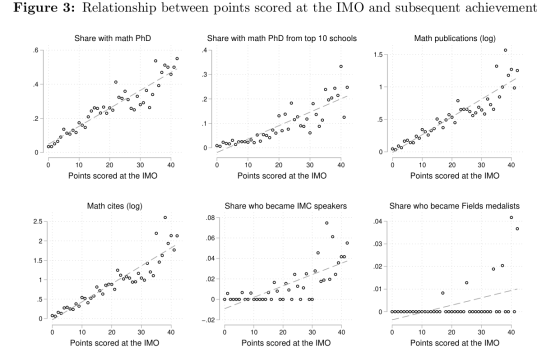
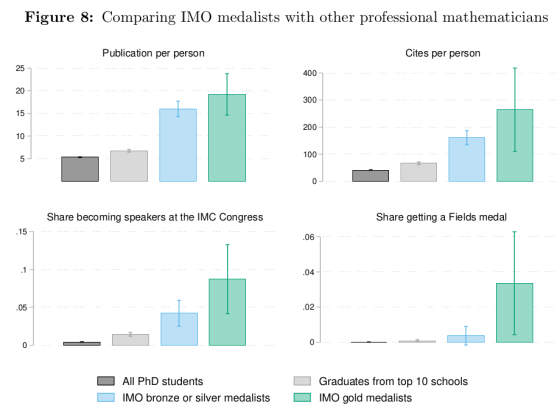
a systematic study of IMO performance versus success as a mathematician later on.
Despite the click-baity title and dreamy introduction about the Millennium Prizes,
the rest of the paper is fascinating, and the figures section is a gold mine.
Here are two that stood out to me:
Points scored at IMO vs subsequent achievements.IMO medalist outcomes.
There’s also one really nice idea they had,
which was to investigate the effect of getting one point less than a gold medal,
versus getting exactly a gold medal.
This is a pretty clever way to account for the effect of the prestige of the IMO,
since “IMO gold” sounds so much better on a CV than “IMO silver” even …
In the previous post we defined p-adic numbers.
This post will state (mostly without proof) some more surprising results about
continuous functions f:Zp→Qp.
Then we give the famous proof of the Skolem-Mahler-Lech theorem using p-adic analysis.
1. Digression on Cp
Before I go on, I want to mention that Qp is not algebraically closed.
So, we can take its algebraic closure Qp — but this
field is now no longer complete (in the topological sense).
However, we can then take the completion of this space to obtain Cp.
In general, completing an algebraically closed field remains algebraically closed,
and so there is a larger space
I think this post is more than two years late in coming, but anywhow…
This post introduces the p-adic integers Zp, and the p-adic numbers Qp.
The one-sentence description is that these are “integers/rationals carrying full
mod pe information” (and only that information).
The first four sections will cover the founding definitions culminating in a
short solution to a USA TST problem.
In this whole post, p is always a prime.
Much of this is based off of Chapter 3A from Straight from the Book.
1. Motivation
Before really telling you what Zp and Qp are,
let me tell you what you might expect them to do.
In elementary/olympiad number theory, we’re already well-familiar …
One of the major headaches of using complex numbers in olympiad geometry
problems is dealing with square roots.
In particular, it is nontrivial to express the incenter of a triangle inscribed
in the unit circle in terms of its vertices.
The following lemma is the standard way to set up the arc midpoints of a triangle.
It appears for example as part (a) of Lemma 6.23.
Theorem 1(Arc midpoint setup for a triangle)
Let ABC be a triangle with circumcircle Γ and let MA, MB, MC
denote the arc midpoints of BC opposite A, CA opposite B,
AB opposite C.
Median Putnam contestants, willing to devote one of the last Saturdays before final exams to a math test,
are likely to receive an advanced degree in the sciences.
It is counterproductive on many levels to leave them feeling like total idiots.
Last February I made a big public apology
for having caused one of the biggest scoring errors in HMMT history,
causing a lot of changes to the list of top individual students.
Pleasantly, I got some nice emails from coaches who reminded me that most
students and teams do not place highly in the tournament,
and at the end of the day the most important thing is that the contestants enjoyed the tournament.
So now I decided I have to apologize for 2016, too.
The story this time is that I inadvertently sent over 100 students home having
solved two …
I recently had a combinatorics paper
appear in the EJC.
In this post I want to brag a bit by telling the “story” of this paper:
what motivated it, how I found the conjecture that I originally did,
and the process that eventually led me to the proof, and so on.
This work was part of the Duluth REU 2017,
and I thank Joe Gallian for suggesting the problem.
1. Background
Let me begin by formulating the problem as it was given to me.
First, here is the definition and notation for a “block-ascending” permutation.
Definition 1. For nonnegative integers a1, …,
an an (a1,…,an)-ascending permutation is a permutation on
{1,2,…,a1+⋯+an} whose descent set is …
I wanted to quickly write this proof up, complete with pictures, so that I won’t forget it again.
In this post I’ll give a combinatorial proof (due to Joyal) of the following:
Theorem 1(Cayley’s Formula)
The number of trees on n labeled vertices is nn−2.
Proof: We are going to construct a bijection between
Functions {1,2,…,n}→{1,2,…,n} (of which there are nn) and
Trees on {1,2,…,n} with two distinguished nodes A and B (possibly A=B).
This will imply the answer.
Let’s look at the first piece of data.
We can visualize it as
I’m reading through Primes of the Form x2+ny2,
by David Cox (it’s good!).
Here are the high-level notes I took on the first chapter, which is about the theory of quadratic forms.
(Meta point re blog: I’m probably going to start posting more and more of these
more high-level notes/sketches on this blog on topics that I’ve been just learning.
Up til now I’ve been mostly only posting things that I understand well and for
which I have a very polished exposition.
But the perfect is the enemy of the good here; given that I’m taking these notes for my own sake,
I may as well share them to help others.)
1. Overview
Definition 1. For us a quadratic form is a polynomial

 Napkin v1.5 (and more)